CASE STUDY
Automated ETL Pipeline For Urban Logistics
Key Business Insights & Recommendations
Based on the extensive exploratory data analysis (EDA) found in the Jupyter Notebooks, several critical business insights were uncovered:
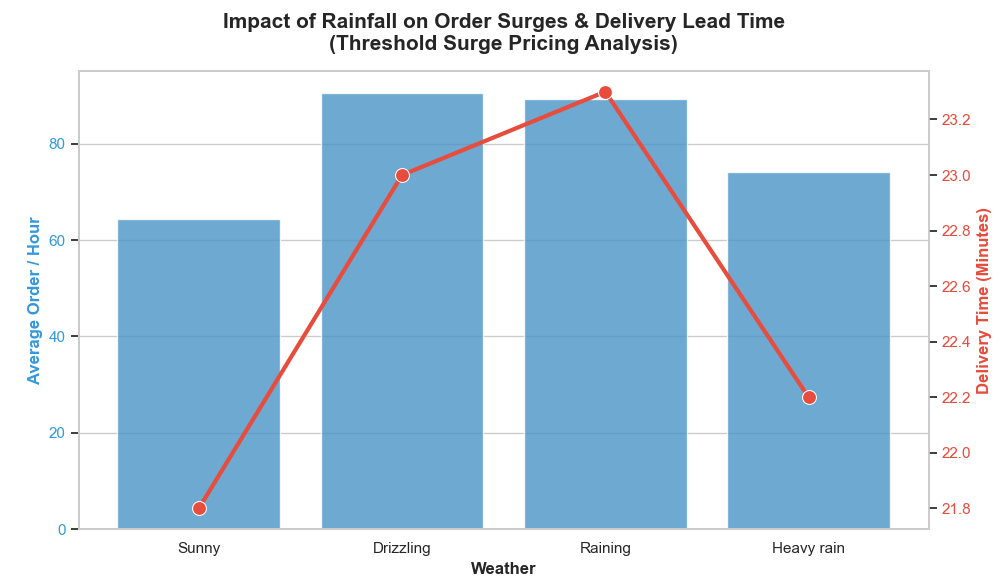
1. Surge Pricing Algorithm Optimization (Weather Impact on Delivery)
Observation: There is a clear correlation between weather conditions and operational metrics. As weather shifts from 'Sunny' to 'Drizzling' and 'Raining', order volumes spike significantly (from 64.4 to 90.6 orders/hour) while average delivery times increase. The heatmap analysis proves that operations are most severely impacted when rain is coupled with moderate-to-strong winds.
Business Recommendation: Implement a multi-tiered Surge Pricing algorithm. Trigger Level 1 Surge during 'Drizzling' conditions to capture the demand spike while maintaining driver supply. Trigger Level 2 Surge (maximum tier) during 'Raining' conditions with 'Moderate/Strong Winds' to compensate for the severe drop in delivery speed and higher safety risks for drivers.
2. NO2 Emissions as a Traffic Proxy: The "Photolysis" Revelation
Observation: The initial hypothesis that Nitrogen Dioxide (NO2) peaks during daytime rush hours was proven false. Due to the Photolysis effect (sunlight breaking down NO2) and Thermal Inversion, NO2 levels actually plummet during the day and skyrocket at night (peaking at ~80 µg/m³ between 22:00 - 23:00). Macro-level satellite data lacks the granularity to differentiate daytime street-level traffic.
Business Recommendation: Pivot from using NO2 as a traffic ETA proxy. Instead, address a critical operational risk: Driver Welfare. Night-shift logistics drivers are exposed to hazardous NO2 levels. The company should mandate and provide N95/KN95 masks as part of standard safety gear for the night fleet to mitigate long-term health liabilities.
3. The "Washout" Effect: Post-Rain PM2.5 Dynamics
Observation: Heavy precipitation (> 7.5 mm) acts as a natural air purifier. The data proves a significant drop in PM2.5 concentrations immediately during and in the hours following heavy rain events.
Business Recommendation: Optimize marketing pushes or delivery promos for "Clean Air Delivery Hours" immediately following rainstorms, capitalizing on higher outdoor activity intent.
4. Health-Tech Marketing Opportunity: Air Temperature vs PM2.5
Observation: There is a distinct correlation between the drop in air temperature at night and the concentration of PM2.5 particles.
Business Recommendation: Implement dynamic app notifications targeting users to order food/groceries delivery during high-pollution/low-temperature evening hours, emphasizing the health benefits of staying indoors.